
Maintaining optimal indoor air quality while controlling energy costs is a critical challenge for managers of large commercial, industrial, and institutional facilities. Heating, ventilation, and air conditioning (HVAC) systems account for a significant portion of a building’s energy consumption, and any inefficiencies in airflow, heat transfer, or microbial control can translate directly into higher utility bills and compromised indoor air quality. Traditional approaches often rely on chemical cleaning of coils and manual system maintenance, but these methods can be labor-intensive, expensive, and sometimes environmentally harmful.
HS Ultra’s innovative UV and ozone retrofit solutions offer a modern alternative—one that simultaneously enhances HVAC efficiency, reduces pathogen loads, and provides chemical-free maintenance. In this post, we’ll explore how these retrofits work, the measurable energy savings they can deliver, and why forward-thinking facility managers are making the switch.
The Energy Challenges in Large HVAC Systems
Large facilities—such as hospitals, universities, office complexes, and manufacturing plants—operate HVAC systems that are complex, multi-zone, and continuously active. Over time, biofilm, mold, and microbial contamination accumulate on coil surfaces and within ductwork, impairing the efficiency of heat exchange and increasing pressure drop across the system.
When coils are coated with biofilm or debris, airflow is restricted, forcing fans and chillers to work harder to maintain the desired temperature. This additional strain not only increases energy consumption but also accelerates wear and tear, leading to higher maintenance costs and potential system downtime.
Traditional cleaning methods, including chemical sprays and manual coil cleaning, address some of these issues but come with limitations:
- Frequent labor requirements – Cleaning coils with chemicals or steam is labor-intensive and often requires system shutdowns.
- Chemical exposure risks – Harsh disinfectants can harm workers, leave residues on HVAC components, and negatively impact indoor air quality.
- Limited ongoing protection – Even after a manual cleaning, coils remain susceptible to rapid microbial regrowth, requiring repeated interventions.
The need for a more sustainable, cost-effective, and consistent solution has never been more pressing, particularly for facilities under strict energy and environmental mandates.
UV and Ozone: How Retrofits Work
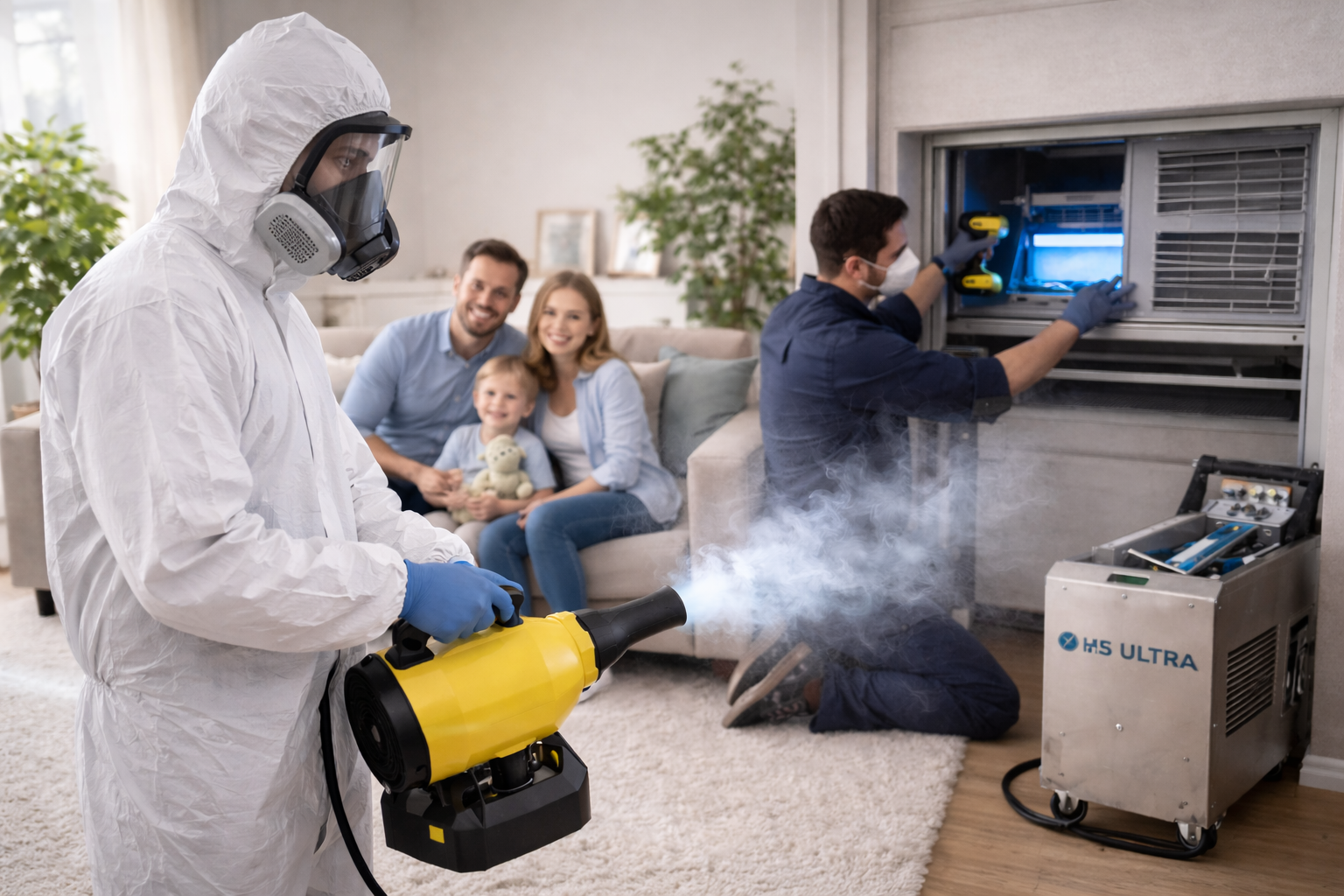
HS Ultra’s approach integrates ultraviolet (UV-C) light and ozone technology directly into existing HVAC systems. This dual-strategy retrofit tackles microbial contamination while maintaining system efficiency, leading to both operational and energy benefits.
UV-C Disinfection
UV-C light, typically in the 254 nm wavelength range, effectively destroys the DNA or RNA of bacteria, viruses, and fungi, preventing reproduction and biofilm formation on coil surfaces. By keeping coils clean and free from microbial buildup, UV retrofits ensure:
- Maximum heat transfer efficiency – Clean coils allow the system to operate at optimal thermal performance, reducing chiller and boiler workload.
- Reduced fan energy use – With fewer obstructions, airflow improves, and fans consume less electricity to move air through the ductwork.
- Ongoing microbial control – Unlike periodic chemical cleaning, UV provides continuous protection, minimizing the need for repeated labor-intensive interventions.
Ozone Integration
Ozone is a powerful oxidizer capable of neutralizing microorganisms and breaking down organic contaminants. When properly integrated into HVAC systems, ozone complements UV-C disinfection by:
- Reaching difficult-to-access areas – Ozone gas penetrates ductwork, coil surfaces, and other hidden zones that are challenging to clean manually.
- Reducing chemical dependency – Facilities can replace traditional coil cleaners and disinfectants with ozone, eliminating hazardous chemicals and supporting environmental sustainability initiatives.
- Improving indoor air quality – By oxidizing organic contaminants before they circulate through the building, ozone helps reduce allergens, odors, and microbial load.
Together, UV and ozone retrofits create a continuous, chemical-free cleaning mechanism that maintains both air quality and system efficiency.
Measurable Energy Savings for Large Facilities
One of the most compelling benefits of UV and ozone retrofits is the direct impact on energy consumption. Studies and field applications have shown measurable reductions in both electricity and heating/cooling demand:
- Fan energy reduction – Cleaner coils reduce airflow resistance, which lowers the energy required to circulate conditioned air throughout large facilities. Depending on the facility and system design, fan energy savings can reach 10–15% annually.
- Improved heat transfer efficiency – When coils are free from biofilm and debris, chillers and boilers operate more efficiently, reducing overall HVAC energy consumption by 5–12%.
- Reduced maintenance-related downtime – Fewer manual cleanings mean fewer system shutdowns and less auxiliary energy used during cleaning processes.
- Long-term operational efficiency – Continuous UV and ozone treatment slows the rate of microbial regrowth, ensuring that energy performance gains persist year-round.
The result is a significant ROI for facility managers: lower utility bills, reduced maintenance costs, and enhanced environmental performance. For large facilities, these savings can translate to tens of thousands of dollars annually, justifying the retrofit investment in a short period.
Compliance and Chemical-Free Maintenance
Beyond energy savings, UV and ozone retrofits help facilities meet indoor air quality (IAQ) and environmental standards without relying on harsh chemicals. This is particularly relevant for hospitals, schools, and food processing plants where occupant safety and regulatory compliance are critical.
Chemical-free maintenance offers several advantages:
- Safer work environments – Maintenance staff are not exposed to hazardous cleaning agents.
- Reduced indoor contamination – No chemical residues are introduced into the airstream, protecting patients, staff, and visitors.
- Sustainability benefits – Facilities can reduce water use, chemical disposal, and environmental impact while meeting energy and hygiene goals.
By combining energy efficiency with chemical-free disinfection, UV and ozone retrofits address both operational and sustainability priorities.
Optimizing Retrofits for Maximum ROI
Not all UV and ozone installations are created equal. To achieve energy savings and effective pathogen control, proper design, placement, and sizing are essential:
- Lamp placement – Strategic positioning across coil surfaces ensures uniform UV exposure and maximizes microbial reduction.
- Ozone dosing – Precise injection systems prevent overuse and ensure safety while targeting microbial hotspots.
- Custom system design – Facilities differ in duct layout, airflow patterns, and occupancy levels; retrofits must be tailored for each environment to deliver maximum efficiency.
HS Ultra combines factory-level expertise with proprietary placement models and real-time monitoring to validate performance, ensuring every retrofit delivers measurable energy savings and improved indoor air quality.
Case Studies: Large Facilities That Benefit
Hospitals
Hospitals have some of the most demanding HVAC requirements, balancing patient comfort, infection control, and energy efficiency. UV and ozone retrofits:
- Reduce biofilm on cooling coils, improving heat transfer and airflow.
- Lower energy use in critical areas such as operating rooms, labs, and patient wings.
- Minimize chemical use, creating safer spaces for patients and staff.
Educational Institutions
Schools and universities experience high-density occupancy, making IAQ critical. Retrofitted systems provide:
- Cleaner air with reduced allergens and microbial load.
- Lower energy costs across gymnasiums, classrooms, and lecture halls.
- Continuous chemical-free maintenance, freeing up custodial staff for other priorities.
Industrial & Manufacturing Facilities
Facilities with large HVAC footprints benefit from:
- Extended equipment life due to reduced coil fouling and strain on fans/chillers.
- Reduced operational costs from fewer chemical purchases and less labor-intensive cleaning.
- Compliance with workplace safety and environmental standards.
Planning and Implementation Considerations
Before retrofitting a system with UV and ozone, facility managers should consider:
- System assessment – Conduct an HVAC audit to identify coil surfaces, airflow patterns, and microbial hotspots.
- Integration planning – Evaluate how UV and ozone systems will fit into existing ductwork and operational schedules.
- Validation & monitoring – Implement monitoring tools to measure microbial reduction and track energy performance.
- Scalability – Choose systems that can expand as facility needs grow or occupancy patterns change.
By taking a structured approach, facilities can maximize ROI, reduce operating costs, and maintain healthier indoor air.
Final Takeaways
UV and ozone retrofits are not just about improved hygiene—they are a strategic investment in energy efficiency, operational savings, and sustainability. By preventing biofilm formation, optimizing coil performance, and reducing chemical use, large facilities can achieve:
- 10–15% fan energy savings
- 5–12% reduction in chiller and heating energy use
- Continuous chemical-free HVAC maintenance
- Improved indoor air quality and pathogen reduction
Forward-thinking facility managers are realizing that these retrofits offer a two-for-one advantage: energy savings and healthier indoor environments, all while supporting sustainability goals.
For hospitals, schools, industrial plants, and commercial buildings, UV and ozone retrofits provide measurable results that pay for themselves over time, transforming HVAC systems into both efficient and hygienic assets.
Take Action Today
Don’t wait for higher energy bills or compromised air quality to drive your next HVAC decision. Contact HS Ultra for a custom UV and ozone retrofit assessment designed to deliver measurable energy savings, chemical-free maintenance, and healthier air throughout your facility.